

Cart
0
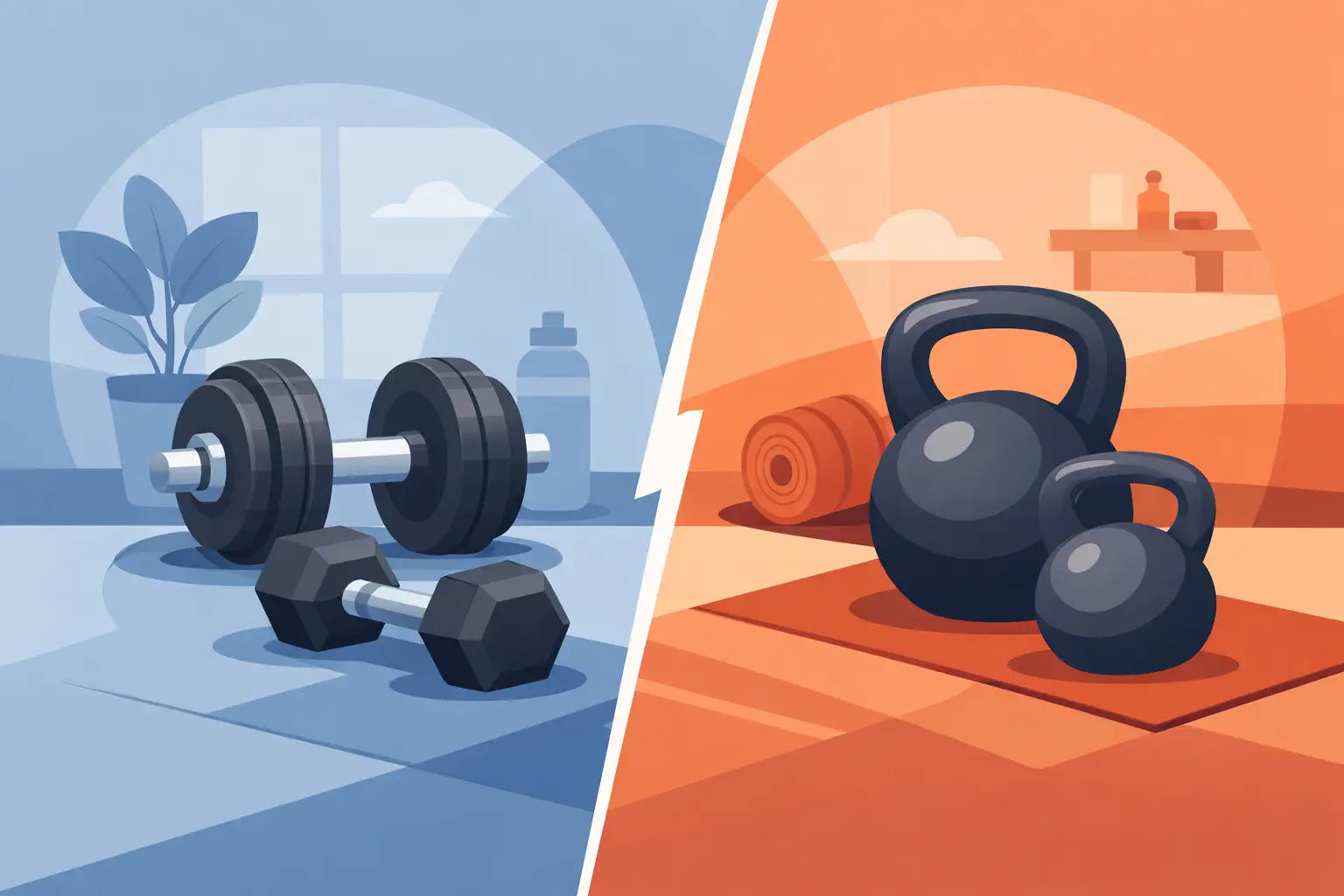
A crowded home gym corner does not make you stronger. The tool you can use consistently does. When comparing dumbbells vs kettlebells, the best choice comes down to how you want to train, how much space you have, and which movements you will actually repeat week after week.
Dumbbells make strength training feel familiar and controlled. Kettlebells bring a more athletic, full-body challenge with fewer pieces of equipment. Neither one is automatically better. Pick the tool that matches your current goal, then put in the reps.
Dumbbells vs Kettlebells: The Main Difference
The biggest difference is where the weight sits in your hand. A dumbbell’s weight is balanced on both sides of the handle. That centered load makes presses, rows, curls, squats, and chest work easier to control. It is a natural starting point for beginners and a reliable option for anyone focused on building muscle and strength with traditional lifts.
A kettlebell has most of its weight below the handle. That offset design changes the feel of every movement. It can challenge your grip, core, shoulders, and coordination while the weight moves through space. Kettlebell swings, cleans, carries, and goblet squats often feel more dynamic because they demand control before, during, and after each rep.
Think of dumbbells as precision tools for strength work. Think of kettlebells as compact tools for strength, conditioning, and powerful movement. Both can make a serious home workout happen.
Choose Dumbbells When Muscle and Control Are the Goal
Dumbbells are hard to beat for straightforward strength training. You can use a pair to train nearly every major muscle group with movements that are easy to learn and easy to adjust. If you want to build your chest, shoulders, arms, back, legs, or glutes, dumbbells give you plenty of options without forcing you into complicated technique.
They also work well when you need to train one side at a time. A single-arm row, split squat, or one-arm overhead press can reveal strength differences between your left and right sides. That matters because imbalances can limit progress and make everyday movement feel less stable.
Dumbbells are especially useful for controlled exercises where the path of the weight matters. A dumbbell bench press, lateral raise, biceps curl, or triceps extension lets you slow down, focus on form, and feel the target muscle working. That control is valuable when your main goal is muscle growth.
Progression is another win. With a range of dumbbell weights, you can make small jumps as you get stronger. Moving from 10 to 15 pounds is less intimidating than making a big leap in load. Adjustable dumbbells can be a smart space-saving option for home lifters who want more variety without buying a full rack.
Dumbbells do have limits. A pair can take up more room than one kettlebell, especially as your strength increases. They are also less natural for explosive, swinging movements. You can still get your heart rate up with dumbbell circuits, but they are not built around ballistic training in the same way.
Choose Kettlebells When You Want Strength and Conditioning
Kettlebells shine when you want a workout that trains strength without separating it completely from cardio. A well-performed swing uses the hips, glutes, hamstrings, core, lats, and grip. Do enough quality reps and your heart rate climbs fast.
That makes kettlebells a strong choice for busy people. One bell can support a challenging full-body session in a small living room, garage, or backyard. Goblet squats build lower-body strength. Rows train the back. Floor presses hit the chest and triceps. Carries build grip and core stability. Swings add power and conditioning.
The uneven load also asks more from your stabilizing muscles. Holding a kettlebell overhead or carrying it at your side forces your trunk to resist twisting and leaning. That can help you build the kind of strength that carries over to lifting groceries, climbing stairs, playing with your kids, and moving with more confidence.
But kettlebells demand respect. The swing is not a squat with arm lift. It is a hip hinge powered by the glutes and hamstrings. If you round your back, pull with your shoulders, or use a weight that is too heavy, the movement can feel rough instead of powerful. Start light enough to learn the pattern, and keep your reps crisp.
Kettlebells can also be less convenient for certain bodybuilding-style exercises. You can press, row, and squat with them, but curls, lateral raises, and some chest movements may feel awkward because of the bell’s shape. If your goal is targeted muscle work, dumbbells usually offer more freedom.
Which Tool Is Better for Beginners?
For most beginners, dumbbells are the easier first purchase. Their balanced design makes basic movements more intuitive, and you can practice at a comfortable pace. A pair of light-to-moderate dumbbells can cover squats, presses, rows, deadlifts, lunges, curls, and core work without a steep learning curve.
That does not mean beginners should avoid kettlebells. A kettlebell is a great first tool if you want simple, full-body workouts and you are willing to learn the hinge before chasing high-rep swings. Start with deadlifts, goblet squats, supported rows, floor presses, and carries. Build skill first. Power comes later.
Your training history matters, too. Someone who already understands a hip hinge from deadlifts may adapt to kettlebells quickly. Someone returning to exercise after time away may get more value from slower dumbbell movements that build confidence and joint control.
How to Match the Tool to Your Goal
If your goal is building visible muscle, dumbbells usually deserve the edge. They make it easier to train muscles through controlled ranges of motion, use different angles, and gradually add weight. They are also better for pairing with a bench, resistance bands, or bodyweight work in a traditional home strength routine.
If your goal is fat loss, endurance, or getting more work done in less time, kettlebells can be a powerful fit. A short circuit of swings, goblet squats, rows, and carries can challenge your whole body without turning your workout into an hour-long event. The catch is that good technique must come first. Fast, sloppy reps do not build grit. They build bad habits.
If you want better overall movement, either tool works. Dumbbells can help you strengthen weak areas with controlled unilateral work. Kettlebells can improve bracing, grip, balance, and hip power. The stronger choice is the one that fills the biggest gap in your current routine.
For a small apartment or limited training space, one kettlebell often delivers more variety per square foot. For a more complete home gym setup, dumbbells offer more precise loading and exercise variety. Many people eventually benefit from both, but you do not need to buy everything at once.
Build a Simple Home Routine Around What You Have
A pair of dumbbells can carry a full-body workout: squat, Romanian deadlift, floor press, bent-over row, overhead press, and a loaded carry. Use a weight that lets you keep solid form for 8 to 12 reps on most exercises. When the final reps no longer challenge you, add weight, add reps, or slow the lowering phase.
With one kettlebell, build around goblet squats, deadlifts, one-arm rows, floor presses, and suitcase carries. Once your hinge is strong, add swings. Keep the bell close to your body, brace your midsection, and drive through the floor with your hips. Start with sets that leave you feeling sharp, not wrecked.
Recovery deserves a place in the plan. Strength improves when training stress is followed by sleep, enough protein, mobility work, and time to recover. A foam roller, massage tool, or a few focused mobility drills will not replace smart programming, but they can help you stay ready for the next session. Train hard, then give your body the support to come back stronger.
The Best Answer Is the One You Will Use
Do not get stuck searching for the perfect piece of equipment. Dumbbells reward steady strength work. Kettlebells reward athletic movement and efficient conditioning. Your budget, space, experience, and goals all matter more than internet arguments.
Start with the tool that makes you want to train this week. Learn a few strong movements, track your reps, and earn the next level through consistency. The weight in your hand matters, but the work you put behind it matters more.

